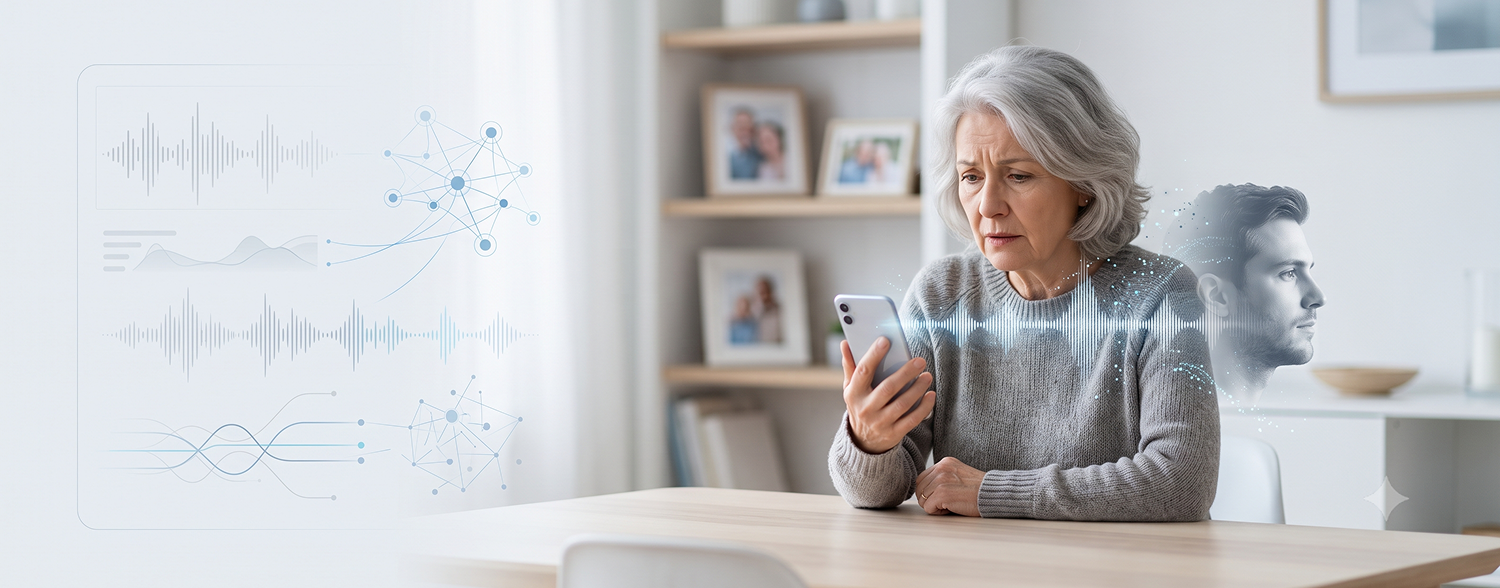
Only a three-second audio clip can now easily fool your loved ones. So, here’s how today’s advanced scam works, the reason why it’s spreading each year, especially this year, and the best ways to prevent or put a complete stop to it.
Jennifer DeStefano was attending her daughter’s dance recital when her phone rang. Watching her daughter’s performance, she answered, and the voice she heard on the other end of the call was familiar. It was her daughter Brianna, sobbing uncontrollably, saying that she’d been in an accident. Suddenly, a man grabbed the phone and started demanding a ransom.
Sounds strange, right? Brianna had been right in front of Jennifer’s eyes, safe the entire time. However, the voice she heard wasn’t her daughter at all. It was an AI-cloned voice built from seconds of audio scraped from social media.
Such incidents are becoming increasingly common and a rising threat today. AI voice scams have increased by 1,210% in the past year. Cybercriminals now need just 3 seconds of audio to convincingly clone the voice of someone you know, as reported by Fox News.
Earlier, such types of online fraud were extremely strenuous. It required the use of high-tech equipment and a good amount of technical knowledge. But today, the whole dynamic has taken a strong turn as anyone with stable internet access can update their scam techniques. And those who pay heavily in the form of ransoms to this shift are the families.
At a Glance
- Fox News / CyberGuy reports that AI voice scams increased by 1,210% in 2025, and these new scams take only three seconds
- Saving Advice reported that 1 in 4 people has been targeted, and losses can exceed $15,000 per incident
- FBI’s IC3 2025 report mentions 22,364 complaints and reported losses of $893 million to AI fraud in one year
- UnboxFuture’s voice cloning reports a rise of 340%, though only 15% of victims report it
- By 2027, deepfake scams would cost $40 billion worldwide, according to SQ Magazine
How the Technology Actually Works
To understand how this scam works, start with how few details AI needs to create a convincing fake voice.
Three Seconds is All it Takes
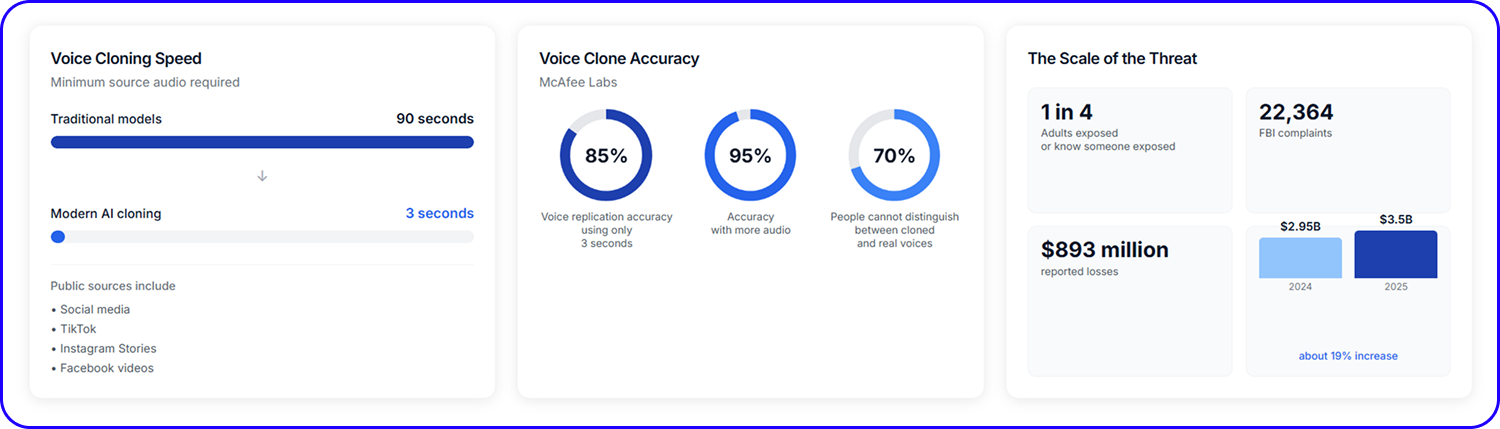
Basic voice cloning models often function with as little as 90 seconds of source audio. However, criminals can generate a convincing clone with only three seconds. They discreetly use publicly available material, such as a social media video, a TikTok clip, an Insta story, or a Facebook clip.
According to a recent McAfee Labs study, AI voice cloning tools can replicate a voice with over 85% accuracy using only a three-second clip. This number rose to 95% with more audio input, and 70% of people fail to differentiate between a clone and a real voice.
Available to Any Criminal, Not Just Experts
AI voice cloning is available today to low-level criminals through “fraud-as-a-service” platforms that are increasingly circulating across the dark web.
This means that such tactics are no longer an advanced nation-state-level attack. It’s now a cheap, accessible tool that places real expertise within reach of almost anyone.
Enriched With Personal Data
Today, scammers use the cloned voice and combine it with data broker profiles that contain a target’s name, relationship details, and location.
This data makes the scenario feel extremely real the moment the phone rings.
The Scale of the Problem
The financial impact has made a huge difference in how federal agencies are tracking scams. The figures show the real image of a threat that’s increasing at an unprecedented pace compared to what families realize.
The Numbers Behind The Calls
A recent global survey by McAfee discovered that one in four adults has been exposed to an AI voice scam or knows someone who has. Considering individual losses, the range is from a few hundred dollars up to $15,000 per incident. Also, 77% of people who had received a cloned-voice call mentioned losing money.
Also, the FBI’s Internet Crime Report has added AI-based scams under its category for the very first time in its 25-year history. The data logged around 22,364 complaints and $893 million worth of financial loss. The report also highlights how seniors lost billions to AI scams in the past year alone. This is why this category is rapidly advancing, according to what the regulators have tracked.
The FTC reported that Americans lost $3.5 billion to imposter scams in 2025, up from $2.95 billion in 2024. This data strongly suggests a steady rise to about 19%, with seniors aged 60 and older holding a larger share of financial losses.
Loss Reaches 20% Across Imposter Scams in a Single Year
Consistent data tracking also revealed that deepfake-supported vishing attacks rose to about 1,600% during Q1 of 2025 compared to earlier periods. Based on reports shared by SQ Magazine, vishing reports account for over 60% of phishing-based incident response engagements.
Additional Interpol reports across industry analysis highlight an annual rise of AI voice-clone cases to over 340%. Also, reports from AdaptiveSecurity recorded an all-time estimate of 85% of victims who backed off from reporting this crime out of embarrassment.
How Fast Voice-Related Scams Have Grown Year Over Year
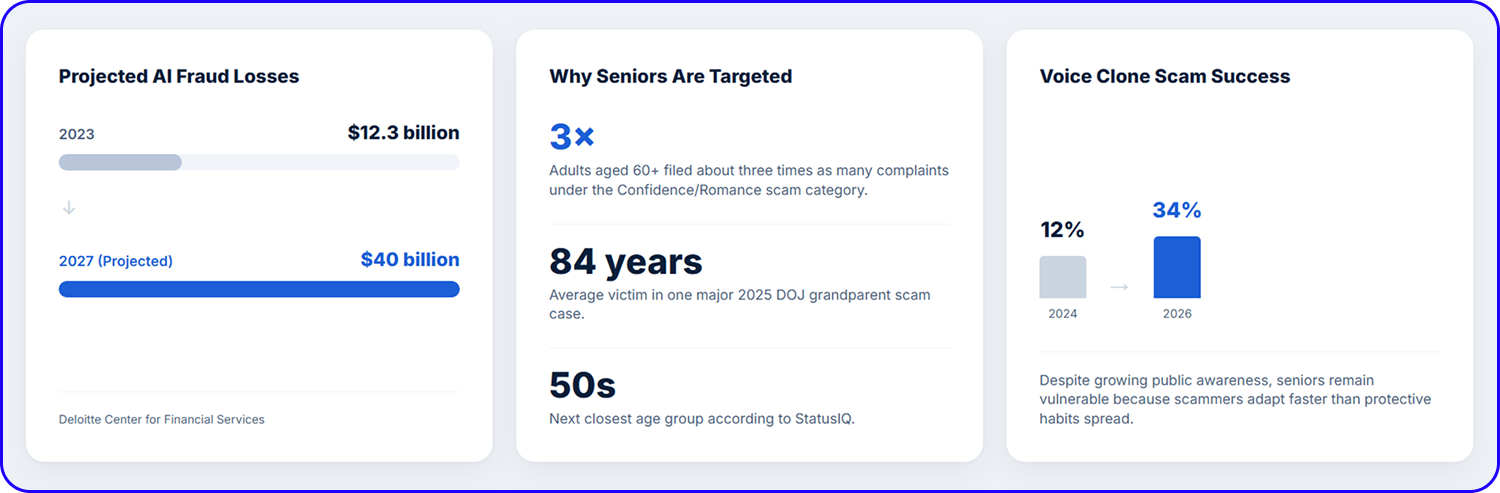
The Deloitte Center for Financial Services also projects generative AI-enabled fraud losses in the United States can reach $40 billion by 2027, which is up from $12.3 billion in 2023.
Why Seniors are the Primary Target
Reportedly, adults over 60 years filed about three times as many complaints under the Confidence/Romance scam category. This included voice-cloning distress calls. According to StatusIQ, the same type of scams were recorded for those in their 50s, the next closest age group. As per data, the average victim in one major 2025 DOJ grandparent scam case was 84 years old.
The success rate of these voice-clone scams has increased from 12% in 2024 to 34% in 2026. The figures indicate that even technically sound adults are being increasingly fooled. Despite the significant number of active campaigns to raise public awareness, seniors remain vulnerable to scammers who consistently adapt their tactics faster than protective habits can spread.
How The Scam Success Rate Shifted
How Seniors & Your Loved Ones Get Manipulated
- The instinct to protect one’s family overrides reasoning almost immediately
- Scammers offer simple corporeal explanations, for example, that they have a bad connection or a broken nose, causing minor audio artifacts
- Elderly people often don’t take the time to think and verify what they’re hearing over the call because of fear
- Scammers often ask victims not to tell their family members, isolating them from the people who could catch the scam
The Actual “Brainwork” Behind This Scam Technique
Typically, all voice cloning attacks follow a similar execution pattern. FBI and FTC reports, as well as industry analysis of AI-powered scams, reveal it is a visible trend.
- A scammer downloads voice samples lasting approximately three to ninety seconds from the social media accounts or other online sites of a relative of the target.
- A quick AI tool helps scammers create the most realistic clone in just a few minutes. According to cybersecurity experts, it is mostly done using a fraud-as-a-service platform.
- These online fraudsters often cross-reference data broker profiles to gather locations, names, relationships, and other personal details to prepare a personalized script.
- Scammers use spoofed numbers, making it hard to identify them as a legitimate threat or emergency.
- The build-up cover story is a faulty signal or broken nose that explains any kind of audio imperfection.
- Those involved in scams will beg their victims not to tell anyone else, which builds a barrier to detection and prevention.
- The financial loss mainly occurs at the last step when the victim is instructed to transfer money through wire, crypto, or by handing over cash to a fake courier at the doorstep.
Reported Real Cases of Financial Losses
The scams are not detected only by the numbers. It’s through people who live through them. One or two documented instances land way harder than any statistics ever reported.
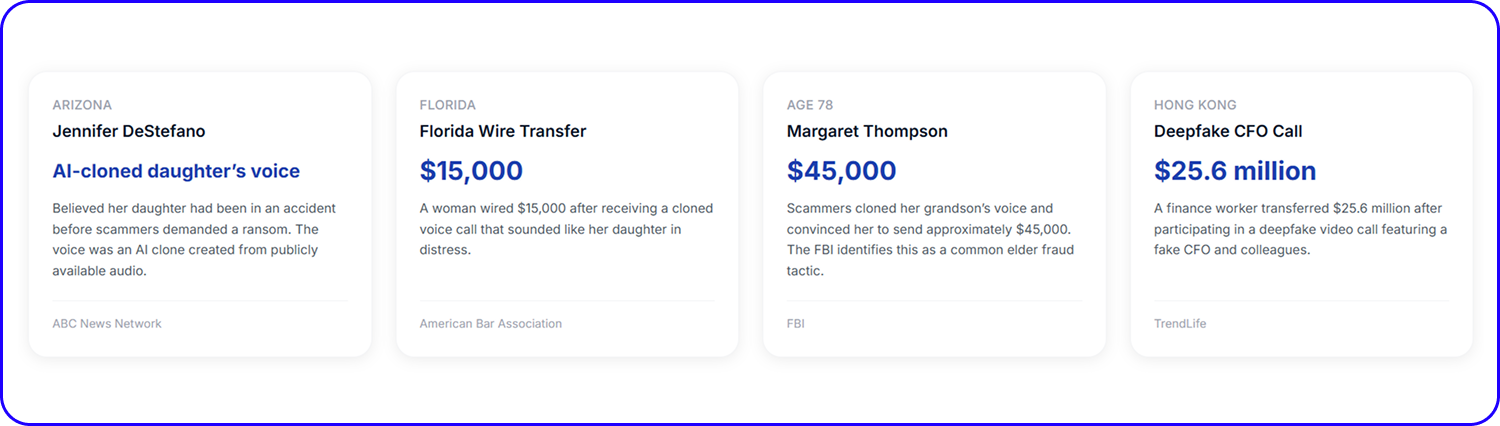
Jennifer DeStefano, Arizona
As documented by ABC News Network, she had received a voice call where she believed that it was her own daughter’s voice saying that she had been in an accident before the fraudsters started demanding a ransom. The voice she heard was an AI clone that scammers picked from publicly available data.
A Florida Wire Transfer
The American Bar Association also reported a case where a woman in Florida wired $15,000 to scammers after receiving a voice call that replicated her daughter’s voice in distress.
Margaret Thompson, 78
This woman had lost around $45,000 when scammers cloned the voice of her grandson begging for help. The scenario that was created here, as the FBI explains, is an extremely common tactic prevalent across elder fraud reporting.
A $25.6 Million Deepfake Call in Hong Kong
TrendLife highlighted an instance where a finance worker made multiple transfers totaling $25.6 million after a deepfake video call featuring a fake CFO and colleagues.
How to Protect Your Family With Real Defenses That Actually Work
Here are the top six ways that your family should approach before the next call strikes. The defenses that really work are effortless, and you don’t need any technical knowledge to implement them.
Establish a Family Code Word
Come to a common ground to pick a secret phrase that only your immediate household members know. If an urgent call suddenly comes demanding ransom, ask for the code word before taking the next step. None of the AI systems can generate a word that it has never heard.
Hang Up and Call Back on a Known Number
Recently issued FTC warning: scammers today are relying on AI to improve family emergency schemes. Also, the only dependable defense approach is to immediately hang up and independently call the family member on the number you’ve already saved instead of trusting any random incoming call.
Treat Urgency as a Red Flag
All legitimate urgency can surely withstand a 60-second call to verify its legitimacy. Scammers will often push their targets to prevent this pause, identifying that pressure as a sign of manipulation instead of a reason to take prompt action.
Lock Down Family Social Media Audio
Ensure you keep your online accounts private, limit sharing video content publicly, and never post audio-rich videos of your kids or grandchildren that scammers can use to clone. The dynamics of children and AI scam risks are extremely real, and just as real as the ones adults face. Kids are an easier target, as their voice from a birthday video or a school recital is seamless ot clone.
Never Send Cash, Wire Transfers, or Cryptocurrency on a Phone Call
Legitimate emergencies, legal, medical, or otherwise, will not ask for an immediate cash payout through wire transfers or crypto. Such a requirement is a standalone sign of a scam, regardless of whose voice is used on the call.
Use a Scam Detection Tool
Online scam detection tools such as TrueDial from Jortty have the potential to flag whether an incoming call is connected to any known scam activity before you answer. This adds a defensive measure before the call hinges on emotionally manipulating you. So, combined use of preventative measures and scam detection tools adds double-layered protection to families instead of depending only on a high-pressure call.
The Best Defense is a Human One
AI hasn’t created new crime. It has made an old crime unrecognizable. A scam that used to take a few hours’ research and an impressive speech now requires just three seconds of audio and a fake number. With an increase of 1,210% in reported cases and confirmation of FBI losses totaling $893 million, families are not becoming careless. This shows that the warning was not changed in time or tool.
What hasn’t changed is what actuallyhalts these calls cold. Family code words take 30 seconds to agree on, meaning any AI will not be able to fake a word it’s never heard. Making a callback to a number you saved will not cost you anything. It will take less than a minute. Just a return to our old habits of placing a high value on family unity. There’s nothing here to learn in the way of new technologies.
Jortty’s TrueDial checks incoming calls against known scam activity in real time, giving families an extra layer of defense before a cloned voice ever gets the chance to manipulate.