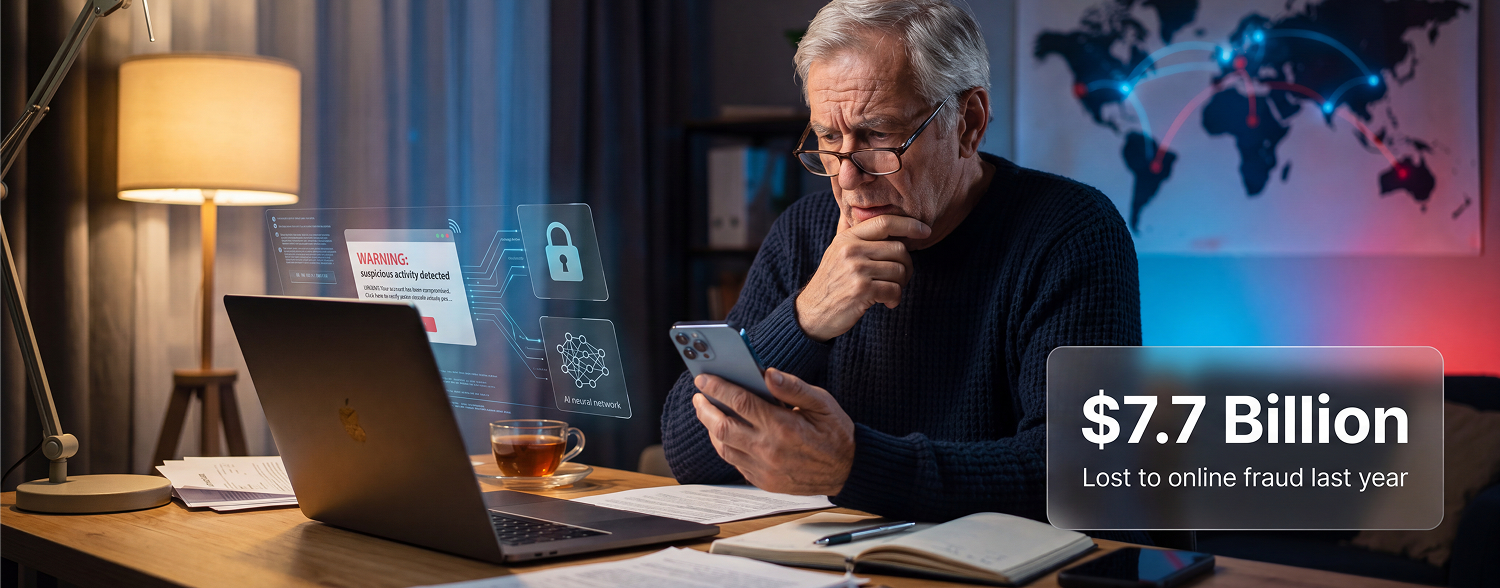
The nature of online scams has become increasingly dynamic over the last twelve months, outpacing anything security researchers have documented previously. According to the Statista study, the global intelligence market is projected to grow from $260 billion in 2025 to nearly $1.2 trillion by 2030. The same tools powering legitimate business automation are now equally accessible to bad actors at near-zero cost. Generative AI allows scammers to create, tailor, and mass-produce convincing communications within seconds — erasing the divide between novice and skilled attackers overnight. The warning signs people once learned to spot — awkward phrasing, typos, impersonal openings — are no longer reliable.
Seniors are already suffering huge financial losses from fraud more than any other demographic. The figures reveal that the difference continues to widen, and the technology driving it is evolving more rapidly than many people assume.
At a Glance
- Hoxhunt’s 2026 Phishing Trends Reportshows that AI-generated phishing attacks increased 14-fold in a single month. The report showed an increase from under 5% to 56% of all detected attacks in December 2025.
- Americans aged 60 and older reported fraud losses amounting to $7.7 billion in 2025, a 59% rise from 2024, according to the FBI’s Internet Crime Complaint Center (IC3 2025 Annual Report).
- The average loss per senior victim reached $38,500, and more than 12,400 victims each lost over $100,000 ( AARP / FBI IC3, 2025).
- AI-related scams cost American seniors $352 million in 2025, affecting 3,143 reported victims. The FBI acknowledges that the true number is likely much higher ( HCSK Analysis).
- Phishing-related losses reported to the FBI soared from $70 million to $215.8 million in 2025, marking an increase of 208% ( Axis Intelligence).
AI Has Changed the Threat Landscape
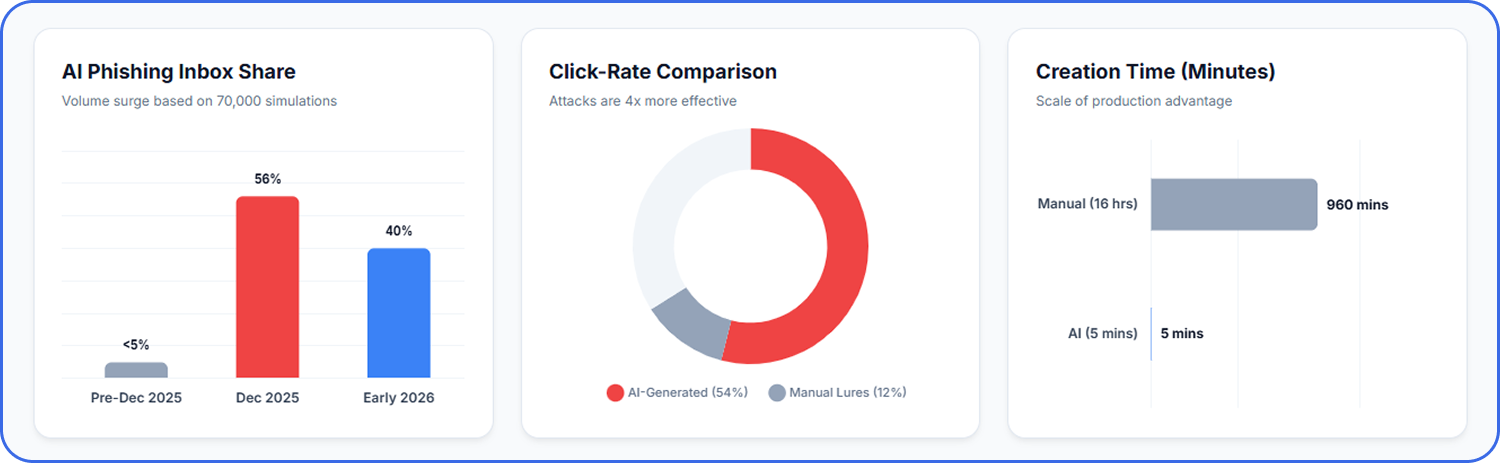
For much of 2025, AI-generated phishing appeared more like a future risk than a present-day problem. Based on Hoxhunt’s research data from about 4 million users and 70,000 simulations over two years, found that AI-generated scams accounted for less than 5% of phishing emails reaching inboxes. The trend shifted in December 2025, when AI-generated phishing increased over 14-fold in just one month, reaching 56% of reported attacks before stabilizing around 40% in early 2026.
These attacks are becoming harder to detect because of their quality, not just their volume. Hoxhunt’s researchers have found that AI-assisted phishing now regularly includes professional formatting, polished grammar, and personal details pulled from public sources, such as names, employers, recent activity, and locations. This makes a message feel more personal than a mass-produced one.
The performance gap has now reached a critical point. Hoxhunt’s long-term study now confirms that AI-generated spear phishing attacks perform 24% better than those created by elite human red teams. Digital Defense’s report on Microsoft discovered that the click-rate gap is now even wider. 54% of AI-generated phishing lures, compared to 12% for manually written lures, are making these attacks four times more effective. IBM’s research also shows the scale of production advantage. This depicts that the work that earlier took skilled attackers 16 hours to create manually now takes AI about 5 minutes. This allows fraudsters to launch attacks that are around 200 times more profitable.
In its March 2026 analysis, Vectra AI found that generative AI-based fraud increased by 1,210% in 2025. Losses from AI-based fraud in the U.S. alone are projected to reach $40 billion in 2027, according to Javelin Strategy & Research.
Seniors Are Absorbing the Financial Damage
The FBI’s Internet Crime Report 2025, released in April 2026 and covering its 26th consecutive year of tracking, reveals how lopsided the losses have turned into:
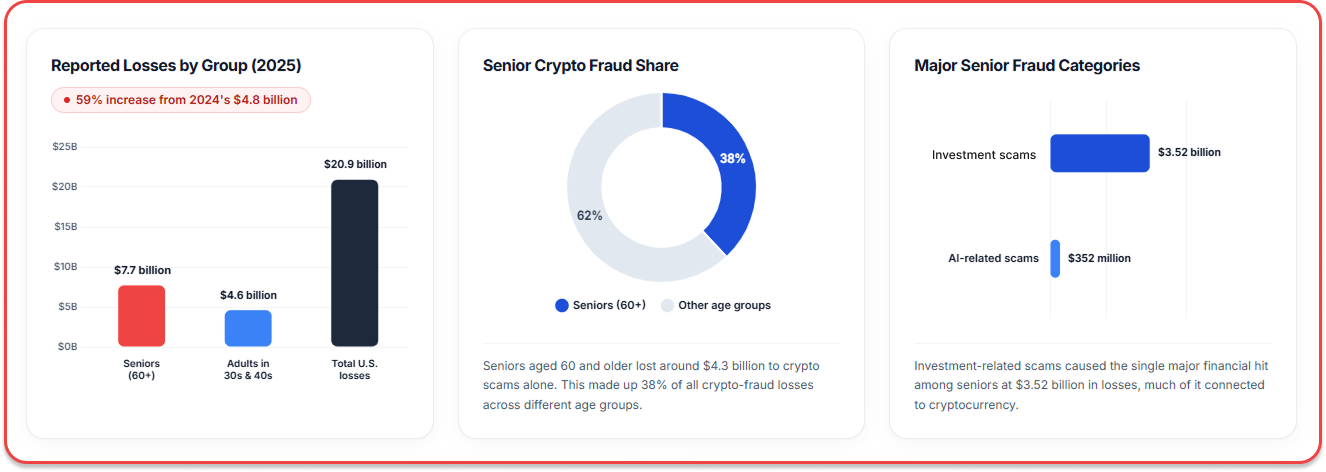
- Seniors aged 60 and older filed around 201,266 complaints and reported $7.7 billion in losses in 2025. A notable 59% increase from 2024’s $4.8 billion.
- $38,500 had been the average loss per senior victim, and more than 12,400 victims lost over $100,000.
- Investment-related scams caused the single major financial hit among seniors at $3.52 billion in losses, much of it connected to cryptocurrency.
- Phishing and spoofing were the most commonly reported scams for this age group. It accounted for about a quarter of all complaints filed by victims aged 60 and older.
- AI-related scams cost seniors $352 million across 3,143 reported victims in 2025 alone (HCSK analysis).
- Seniors aged 60 and older lost around $4.3 billion to crypto scams alone. This made up 38% of all crypto-fraud losses across different age groups.
Adults in their 30s and 40s reported $4.6 billion worth of losses, less than what seniors reported independently. Total US cybercrime losses reached $20.9 billion in 2025, a 26% increase from the previous year and the first time in the BI’s annual tally to surpass $20 billion.
AARP’s independent, broader estimate of $28 billion lost annually by Americans aged 60 and older to financial exploitation captures cases that were never reported. The FBI itself conveys that its figures are more likely to represent a notable undercount since most older victims hold back from reporting fraud due to uncertainty about where to turn or embarrassment. The FTC estimates that only 4.8% of mass-market fraud victims ever file a complaint with a government body (Axis Intelligence, 2026).
Why Older Adults Are More Vulnerable to AI-Era Scams
For several reasons, adults are at higher risk, and AI has dismantled barriers that once offered protection.
Outdated Red Flags are No Longer Reliable
We no longer see the familiar signs of bad grammar, awkward formatting, or a generic greeting. The results of the Sift Digital Trust Index Q2 2025 mention that 82% of malicious emails were AI-generated. This indicates that the checklist most people were trained to use earlier isn’t catching most of the attacks.
Lower Digital Confidence
Many seniors lack the experience to assess whether a call, text, or website is genuine. The rise of new attack technologies is outpacing the public’s awareness as the gap widens (NCOA, 2026).
Trust in Authority Figures
Scammers are adopting the identities of those brands that seniors are most likely to trust – banks, the government, and tech support. In 2025, the FBI received 32,000 complaints regarding impersonation, resulting in $798 million in fraud losses.
Urgency and Fear as Override Mechanisms
Messages regarding frozen accounts, unpaid taxes, and arrest warrants are meant to confuse people. Due to intentional pressure, victims do not check.
Voice and Video are No Longer Trustworthy
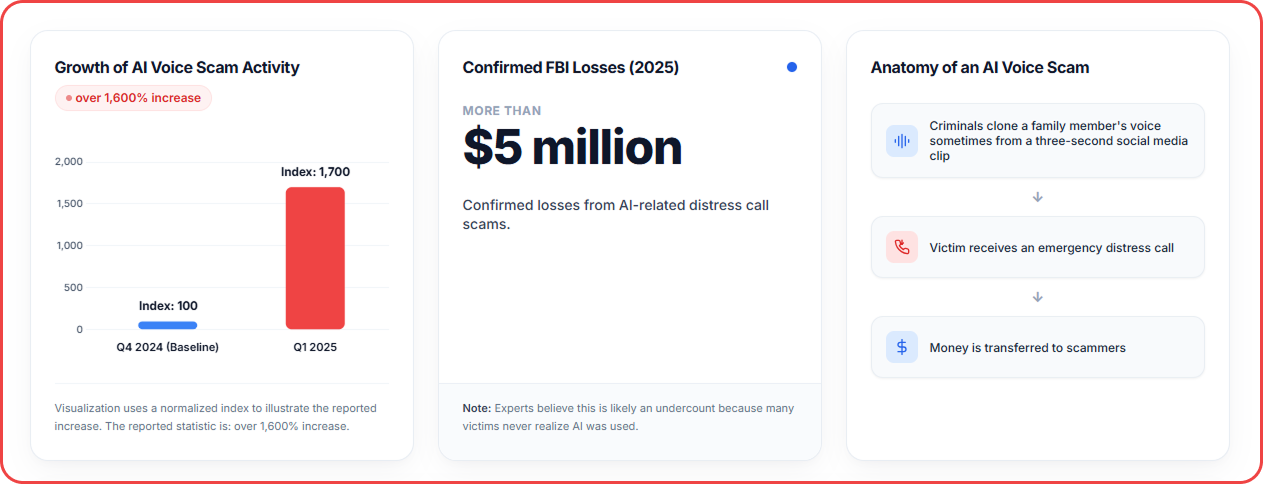
Scammers now use as little as 3 seconds of audio to duplicate a family member’s voice. Global research by McAfee, involving over 7,000 people, found that almost 25% of adults have seen or know someone who has seen an AI voice scam. Of those who got cloned voice messages, 77% reported losing money, ranging from $500 to $15,000.

The Scams Showing Up Most Often
AI Phishing Emails
Completely refined messages made to look like real bank notices, delivery updates, or government correspondence, with tones and formatting that no longer give them away. Phishing was the most complained-about cybercrime category in the US for the third straight year in 2025. There were 191,561 complaints.
Tech Support Scams
A caller or pop-up claims that your device is compromised and asks you to pay or give them remote access. Scripts produced by artificial intelligence make these conversations seem normal and less fake. Tech support scams were ranked among the top five by both victim count and dollar loss per victim.
AI Voice Cloning
Popular criminals are cloning a family member’s voice, sometimes from a three-second social media clip, and creating an emergency. Deepfake-enabled voice scams increased by over 1,600% in the first quarter of 2025 compared to the fourth quarter of 2024. The FBI recorded scams related to distress calls involving AI in 2025. This resulted in confirmed losses of more than $5 million, an undercount, according to experts, since many victims never realize AI was used. In 2025, a Florida woman sent $15,000 to scammers after receiving a call from what she believed was her daughter’s voice (American Bar Association, September 2025).
Brand Impersonation
Fraudulent emails that appear to originate from Microsoft, PayPal, Amazon, or DocuSign remain a prime tool. They usually warn of a suspicious charge, a locked account, or a failed delivery that requires urgent action. A logo that people recognize takes away most of the scrutiny you might otherwise apply, which is also why it works.
AI Recovery Scams
After a victim has already been scammed, the criminals return, posing as law enforcement, attorneys, or recovery firms, and promise to get your money back for a fee. AI allows them to imitate the voices of actual FBI agents to make false official documentation for people who have already suffered devastating losses (HCSK, May 2026).
How Seniors Can Protect Themselves
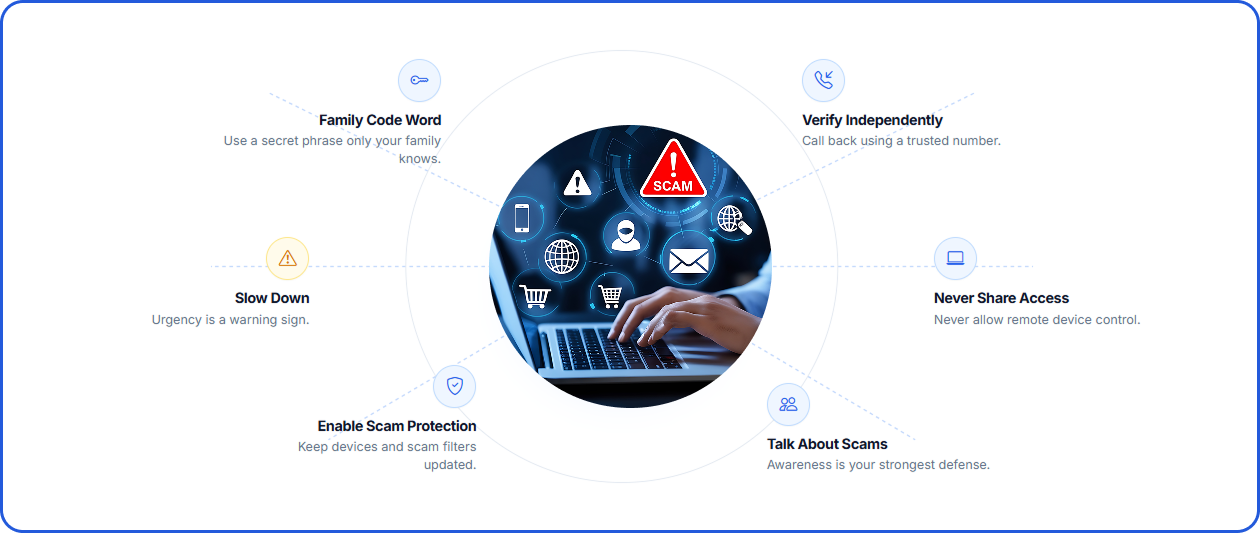
Establish a Family Code Word
Agree on a secret phrase only close family members know. If you receive an emergency call asking for money, ask for the code word. No AI can produce something it has never heard.
Verify Through a Separate Channel
If a loved one calls from an unfamiliar number claiming to be in trouble, hang up and call them back on their known number. If a company contacts you urgently, call the number on their official website and not the one in the message.
Treat Urgency as a Red Flag, Not a Reason to Act
Legitimate banks, government agencies, and companies do not demand immediate action under threat of arrest, account closure, or legal consequences. Pressure is the mechanism — slow down (FBI, Elder Fraud).
Never Grant Remote Device Access on Request
No legitimate company asks unprompted for access to your device, regardless of how official the request sounds.
Use Built-in Scam Detection Tools
Email providers, browsers, and mobile carriers automatically filter out a meaningful share of malicious email. Using scam protection tools and keeping software up to date can also help reduce the risk of scams.
Talk to Family Openly
Research by FINRA shows that consumers who have heard about a particular scam are 80% less likely to engage and 40% less likely to lose money if they do engage. (JD Supra). Awareness is a measurable defense.
The Old Playbook Is Gone. Here’s What Actually Works Now
AI has not invented new scams; it has made the old ones faster, more convincing, and far more scalable. The financial toll on older Americans is rising accordingly: $7.7 billion in reported losses in 2025, a 59% jump in a single year, with the true total almost certainly several times higher.
The instinct to pause, verify through a separate channel, and question anything demanding immediate action now matters more than the old checklist of spelling errors and generic greetings. Those tales are gone. What replaces them is a habit and not a list.
Families should discuss these risks openly, and older adults should feel comfortable asking for a second opinion before acting on any unexpected message or call. The defenses that work are simple, low-tech, and consistently underused.